 puzz
puzzFree number pyramid worksheets
A number pyramid, also known as an addition pyramid, a maths pyramid or a number wall, is a stack of bricks where every brick holds the sum of the two bricks directly beneath it. Some bricks are filled in, most are blank, and the child works out the rest. It is the rare worksheet that drills number bonds hard while still feeling like a puzzle rather than a page of sums.
What makes a pyramid worth printing is that it runs in two directions. Adding upwards is easy to teach. But when the brick above is known and only one brick below it is filled, the child has to subtract to get the other. Nobody points that out to them. They notice it themselves. The medium and tricky packs are built so that addition alone will always stall, which is exactly the moment a child discovers subtraction is the inverse of addition rather than being told so.
The 3 free number pyramid packs
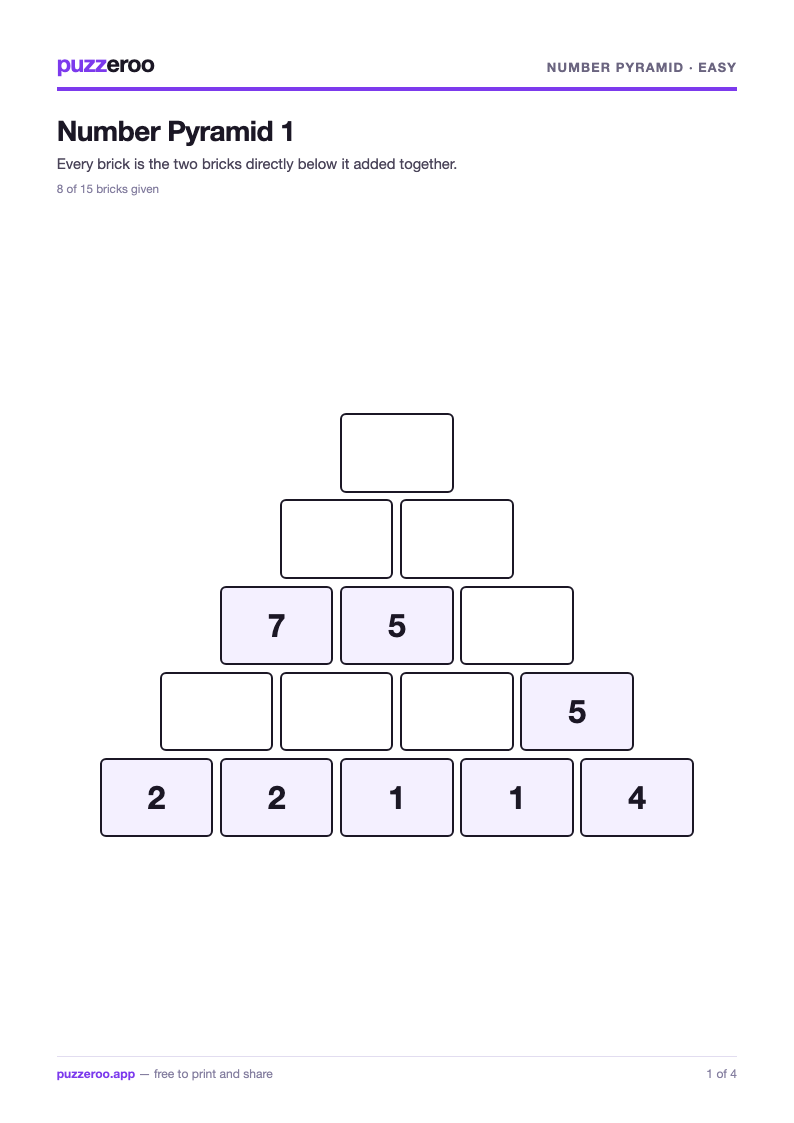
Easy
Three free printable easy number pyramid worksheets with answers.
Download the PDF →
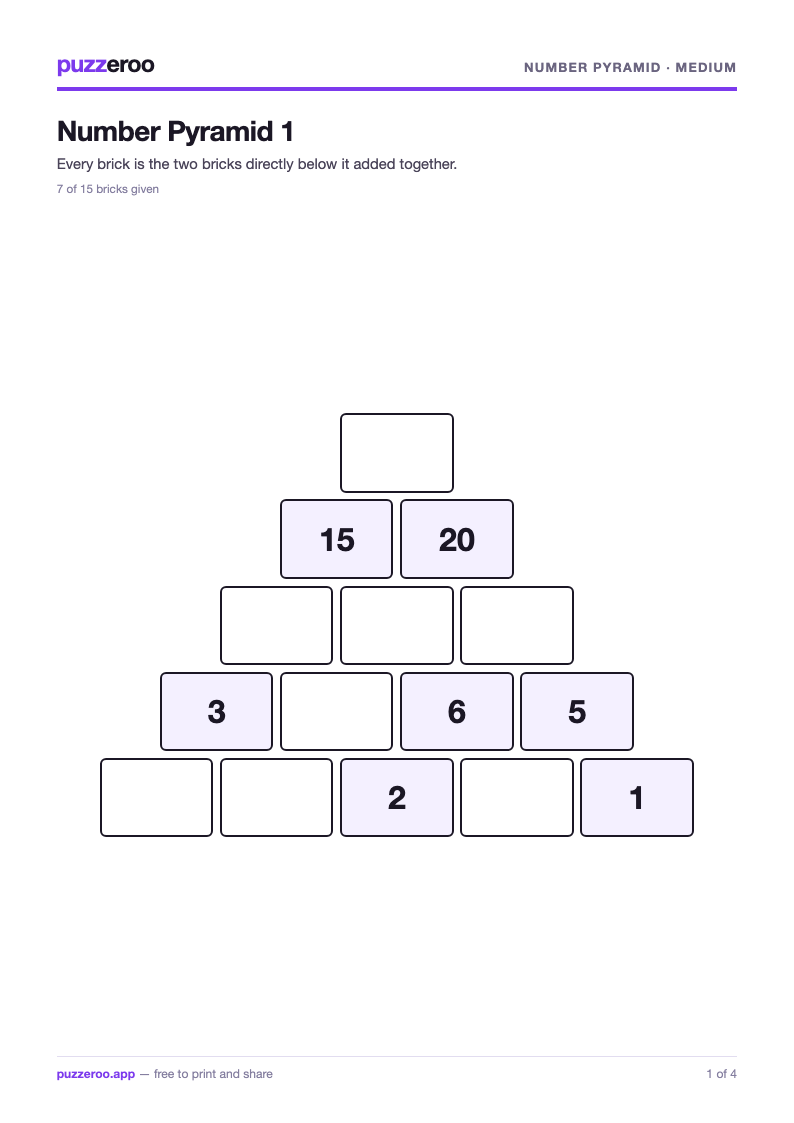
Medium
Three free printable medium number pyramid puzzles with answers, ages 7-10.
Download the PDF →
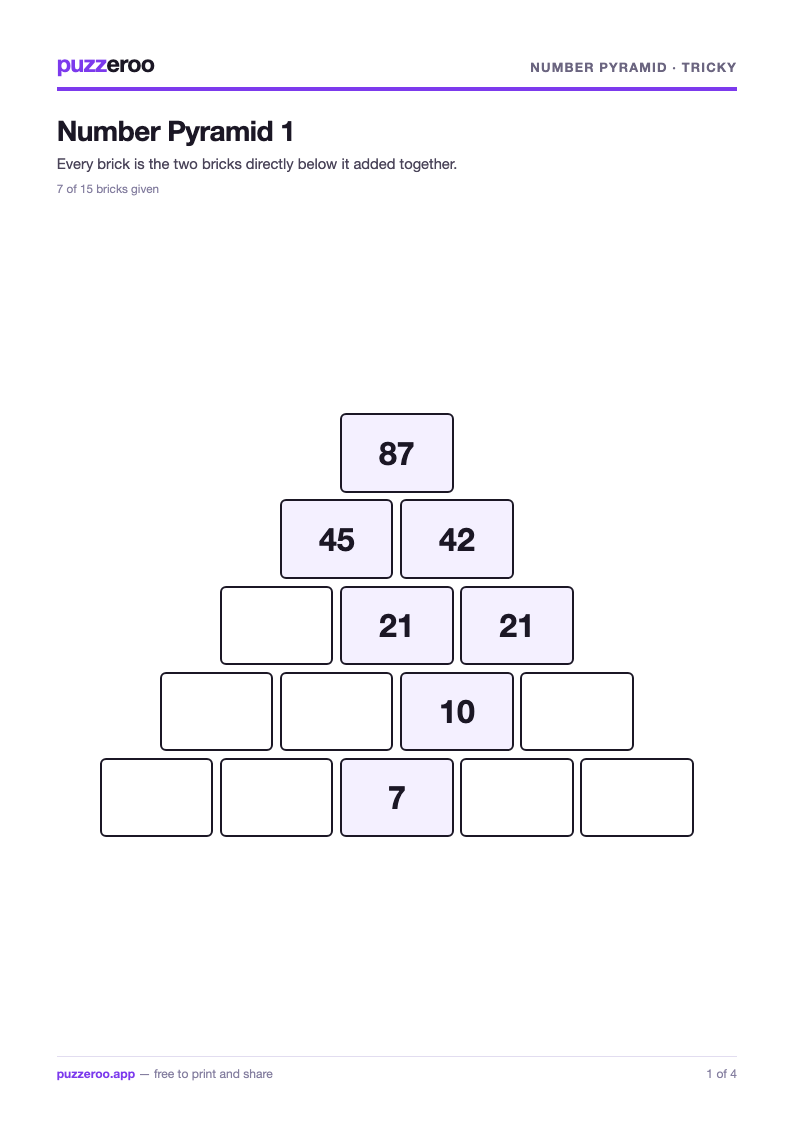
Tricky
Three free printable hard number pyramid worksheets with answers, ages 9-12.
Download the PDF →
- Four A4 pagesThree puzzles, then a full answer key. Print the first three only if you would rather keep the answers.
- One verified solution eachEvery puzzle is passed through a solver and discarded unless exactly one answer fits.
- No sign-up, no watermarkA direct PDF download. No email address, no account, nothing to dismiss.
- Free to photocopyUse them at home, in a classroom, at a childminder or in a holiday club.
Which pack for which age?
| Number Pyramid pack | Ages | What it asks of them |
|---|---|---|
| Easy | 6-8 | Small numbers, apex usually under 40. Finishes with addition alone, no subtraction needed. |
| Medium | 7-10 | Built so addition stalls. The child must work at least one brick out by subtracting. |
| Tricky | 9-12 | Bigger numbers and sparser clues; needs several subtraction steps and some planning. |
How to solve a number pyramid
Five bricks along the bottom, narrowing to one at the top. Everything follows from a single relationship.
- Learn the one ruleEvery brick equals the two bricks immediately below it added together. That single rule works everywhere in the pyramid, in both directions, and there are no other rules to remember.
- Fill in every pair you can addScan the pyramid for any place where two side-by-side bricks are both filled and the brick above them is empty. Add them, write the total above, and repeat. Do this until no more pairs are available. On an easy pyramid this alone finishes the puzzle.
- Turn it round and subtractNow look for a filled brick whose two children include exactly one filled brick. The missing one is the brick above minus the one you know. If the top is 12 and one brick below is 5, the other must be 7. Say it out loud as a subtraction the first few times.
- Alternate until it closesKeep swapping between adding upwards and subtracting downwards. Each new brick unlocks fresh pairs in both directions, so the pyramid tends to finish in a rush once the first few stubborn bricks fall.
- Check the topWhen every brick is filled, re-add the whole pyramid from the bottom row up. If you arrive at the same number at the apex, the pyramid is right. A wrong brick almost always shows up as a mismatch at the top.
Common questions
What is a number pyramid?
A triangle of bricks, five wide at the base and one at the top, where each brick contains the sum of the two bricks directly below it. Some bricks are given and the rest are blank. It is also called an addition pyramid, a maths pyramid or a number wall.
How do you work out a missing number lower down the pyramid?
Subtract. If you know a brick and one of the two bricks beneath it, the other brick beneath is the top one minus the one you know. Children usually find upward addition immediately and need a nudge towards this downward step the first time.
Which year group are addition pyramids for?
The easy pack suits Year 2 to Year 3 (US grades 1-2) for number-bond practice. Medium fits Year 3 to Year 5 (grades 2-4). The tricky pack works well as an extension task up to Year 7 (grade 6) because the arithmetic stays simple while the reasoning does not.
Do the puzzles have only one answer?
Yes. Each pyramid is checked by a solver and discarded unless exactly one set of numbers fits. Children cannot arrive at a different-but-also-valid pyramid, so the answer key is definitive.
Are negative numbers or fractions ever used?
No. Every brick in every pyramid here is a positive whole number, bottom row included. There is nothing on these sheets a child working with whole-number addition cannot attempt.
Other free printable puzzles
The same puzzles, on an iPad
Puzzeroo has two hundred number pyramid levels and six hundred more across the other three puzzle types. It works fully offline, shows no adverts, asks for no account, and costs one payment rather than a subscription. The worksheets above are generated from a separate puzzle range, so they never duplicate a level in the app.