 puzz
puzzTricky printable number pyramid puzzles
Clues are sparse and scattered on the tricky pyramids, so there is rarely an obvious opening move. The child has to survey the whole pyramid, find the one place where a step is available, take it, and then survey again. Several rounds of subtracting downwards are needed before the addition starts flowing, and the apex typically lands somewhere between eighty and a hundred and ten rather than in the twenties.
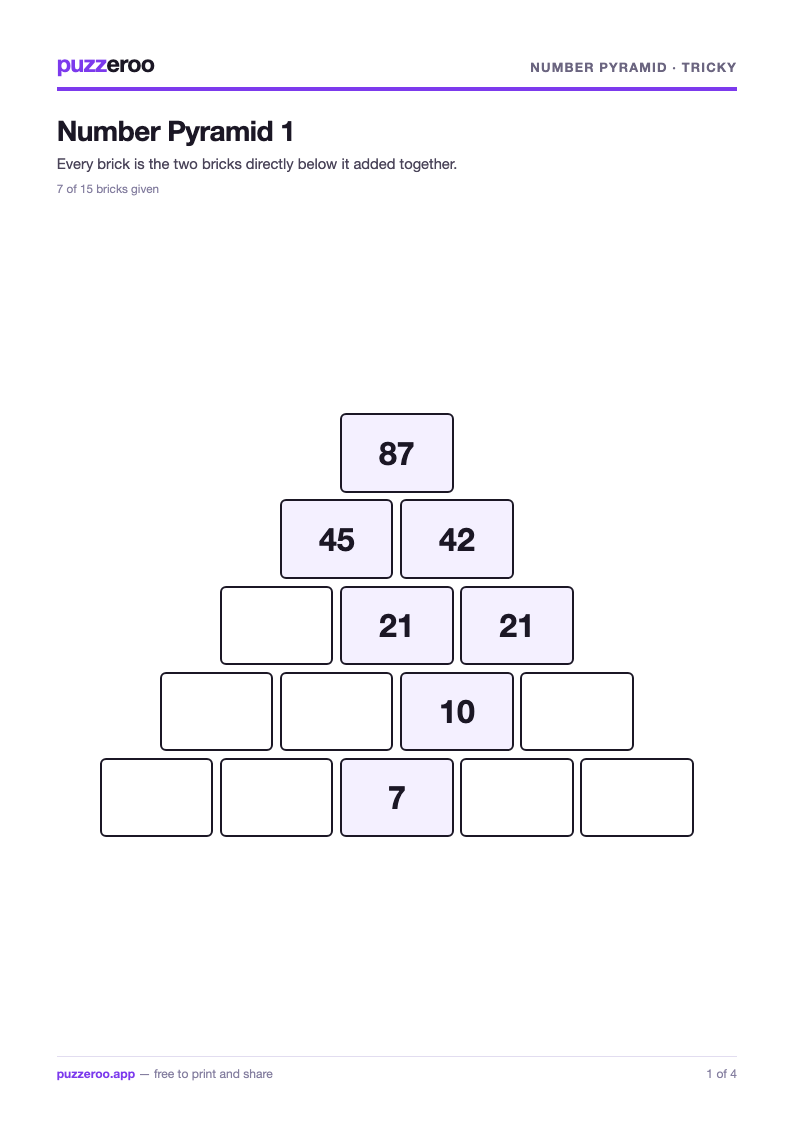
This is the pack to reach for when a strong mathematician has finished everything else. The numbers are larger than on the easy pack, but each individual step is still a two-number addition or subtraction. The difficulty lives in working out which step is available, not in the arithmetic. Expect ten minutes a puzzle, and expect a false start or two.
What is in this pack
| Shape | fifteen bricks, five along the base | |
|---|---|---|
| Clues | around seven of fifteen, deliberately awkwardly placed | |
| Solving level | multiple subtraction steps, and some planning about where to start | |
| Best for | extension and enrichment, Year 5-7 / US grades 4-6 | |
- Four A4 pagesThree puzzles, then a full answer key. Print the first three only if you would rather keep the answers.
- One verified solution eachEvery puzzle is passed through a solver and discarded unless exactly one answer fits.
- No sign-up, no watermarkA direct PDF download. No email address, no account, nothing to dismiss.
- Free to photocopyUse them at home, in a classroom, at a childminder or in a holiday club.
Teaching tip. Suggest writing lightly in pencil and, when a brick is deduced, immediately checking whether it unlocks anything in both directions before moving on. Children lose most of their time here by deducing a brick and then forgetting to use it.
How to solve a number pyramid
Five bricks along the bottom, narrowing to one at the top. Everything follows from a single relationship.
- Learn the one ruleEvery brick equals the two bricks immediately below it added together. That single rule works everywhere in the pyramid, in both directions, and there are no other rules to remember.
- Fill in every pair you can addScan the pyramid for any place where two side-by-side bricks are both filled and the brick above them is empty. Add them, write the total above, and repeat. Do this until no more pairs are available. On an easy pyramid this alone finishes the puzzle.
- Turn it round and subtractNow look for a filled brick whose two children include exactly one filled brick. The missing one is the brick above minus the one you know. If the top is 12 and one brick below is 5, the other must be 7. Say it out loud as a subtraction the first few times.
- Alternate until it closesKeep swapping between adding upwards and subtracting downwards. Each new brick unlocks fresh pairs in both directions, so the pyramid tends to finish in a rush once the first few stubborn bricks fall.
- Check the topWhen every brick is filled, re-add the whole pyramid from the bottom row up. If you arrive at the same number at the apex, the pyramid is right. A wrong brick almost always shows up as a mismatch at the top.
Who this pack suits
Bigger numbers and sparser clues; needs several subtraction steps and some planning.
How the number pyramid packs compare
| Number Pyramid pack | Ages | What it asks of them |
|---|---|---|
| Easy | 6-8 | Small numbers, apex usually under 40. Finishes with addition alone, no subtraction needed. |
| Medium | 7-10 | Built so addition stalls. The child must work at least one brick out by subtracting. |
| Tricky | 9-12 | Bigger numbers and sparser clues; needs several subtraction steps and some planning. |
Questions about this pack
How is the tricky pack different from medium?
Fewer clues, placed further apart, and more subtraction steps needed before the pyramid opens up. Medium usually has one obvious stall with one obvious way past it; tricky can stall several times and the openings are harder to spot.
Does harder mean bigger numbers?
Partly. The apex on a tricky pyramid is usually between eighty and a hundred and ten, against the twenties on the easy pack. But every individual step is still adding or subtracting two numbers, so the arithmetic never gets beyond two-digit mental work. The difficulty is spotting which step is available.
Could this work as a classroom extension task?
It is designed for it. One A4 puzzle, no explanation needed beyond the rule, no equipment, and a definitive answer key. It drops straight into a fast-finisher tray.
What if my child arrives at a different answer that also works?
They will not, because a solver checks that exactly one set of numbers fits before the puzzle is printed. A mismatch with the answer key is an arithmetic slip, and re-adding the pyramid from the base upwards will find it.
More free worksheets
Other number pyramid packs
Other kinds of puzzle
See all 17 free worksheet packs.
Hundreds more of these in the app
Puzzeroo is an iPhone and iPad app with two hundred number pyramid levels alongside three other puzzle types, eight hundred in total. The same verified engines that made this worksheet made every one of them, and they all work fully offline with no adverts and no accounts. The worksheets and the app draw from separate puzzle ranges, so printing these gives nothing away.