 puzz
puzzFree printable sudoku for kids
Ordinary 9x9 sudoku is a wall for most under-tens: too many cells, too much scanning, and a first sitting that ends in a rubbed-out mess. These worksheets shrink the board instead of watering down the logic. A 4x4 grid asks a five-year-old for exactly the same reasoning as a broadsheet puzzle: this row already has a 3, so this cell cannot be a 3. The difference is that the whole board fits in one glance.
Every grid below was produced by the same generator that powers the Puzzeroo app, and every one is checked by a solver before it is printed. That matters more than it sounds: a sudoku with two valid answers is worse than no sudoku at all, because a child can fill it in correctly and still be marked wrong against the answer key. Nothing here needs guessing, and nothing here has a second solution.
The 4 free kids sudoku packs
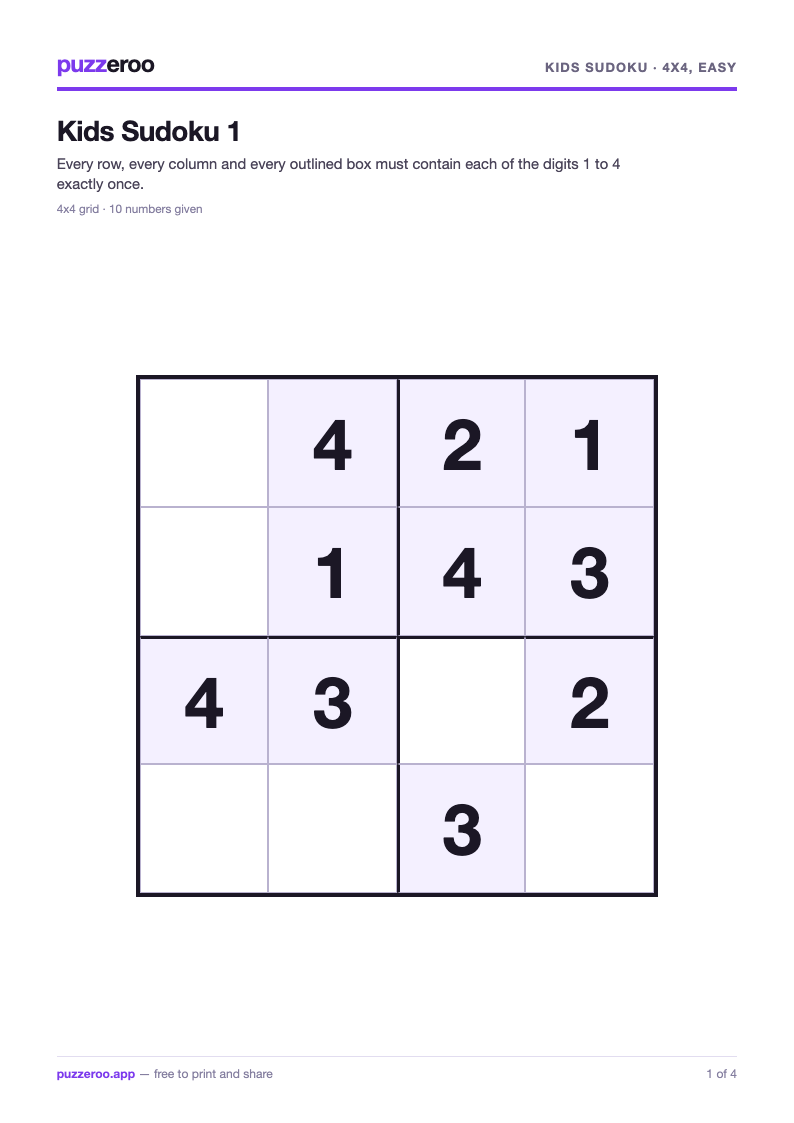
4x4, easy
Three free printable 4x4 sudoku puzzles for children aged 5-7, with answers.
Download the PDF →
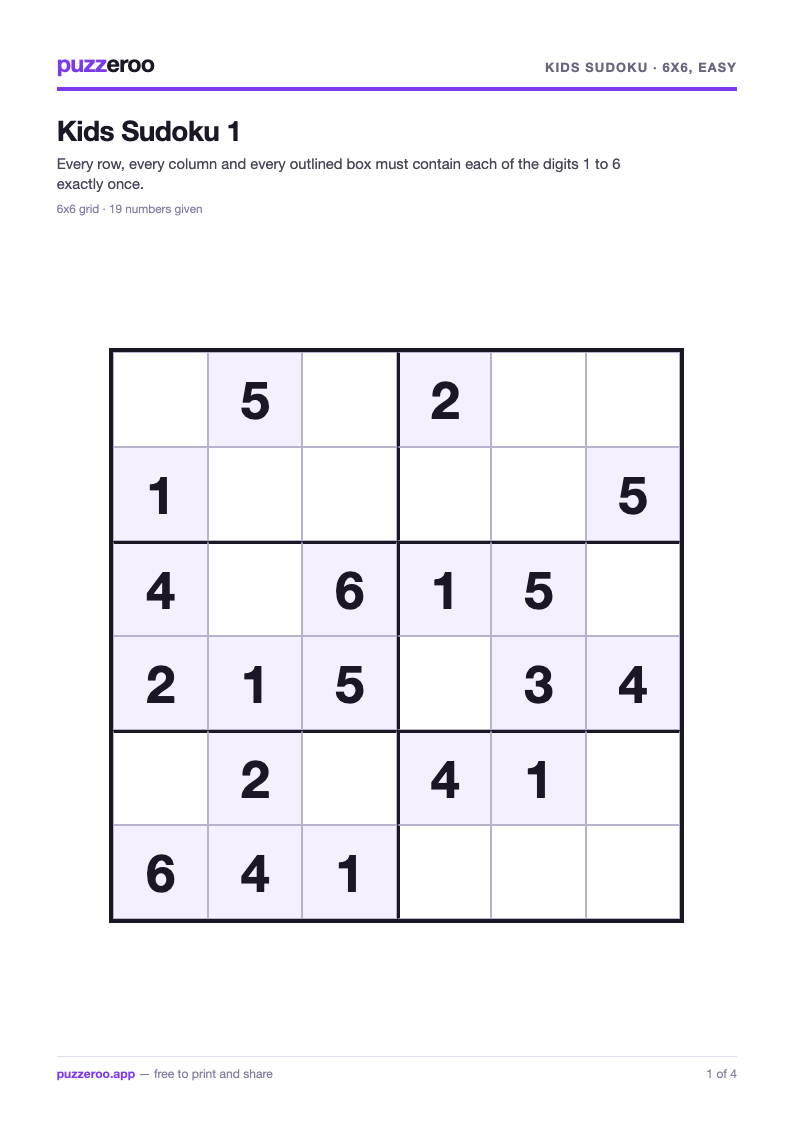
6x6, easy
Three free printable 6x6 sudoku puzzles for children aged 6-8, with an answer key.
Download the PDF →
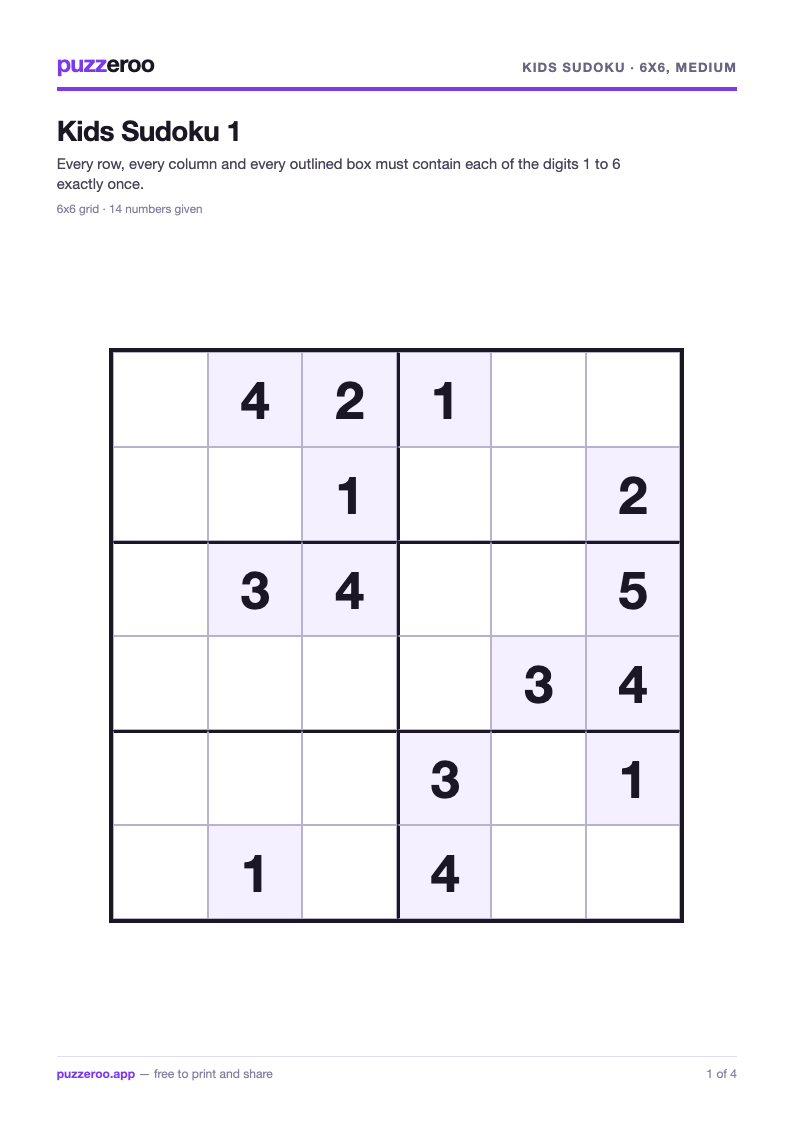
6x6, medium
Three free printable medium 6x6 sudoku puzzles for ages 8-10, with answers.
Download the PDF →
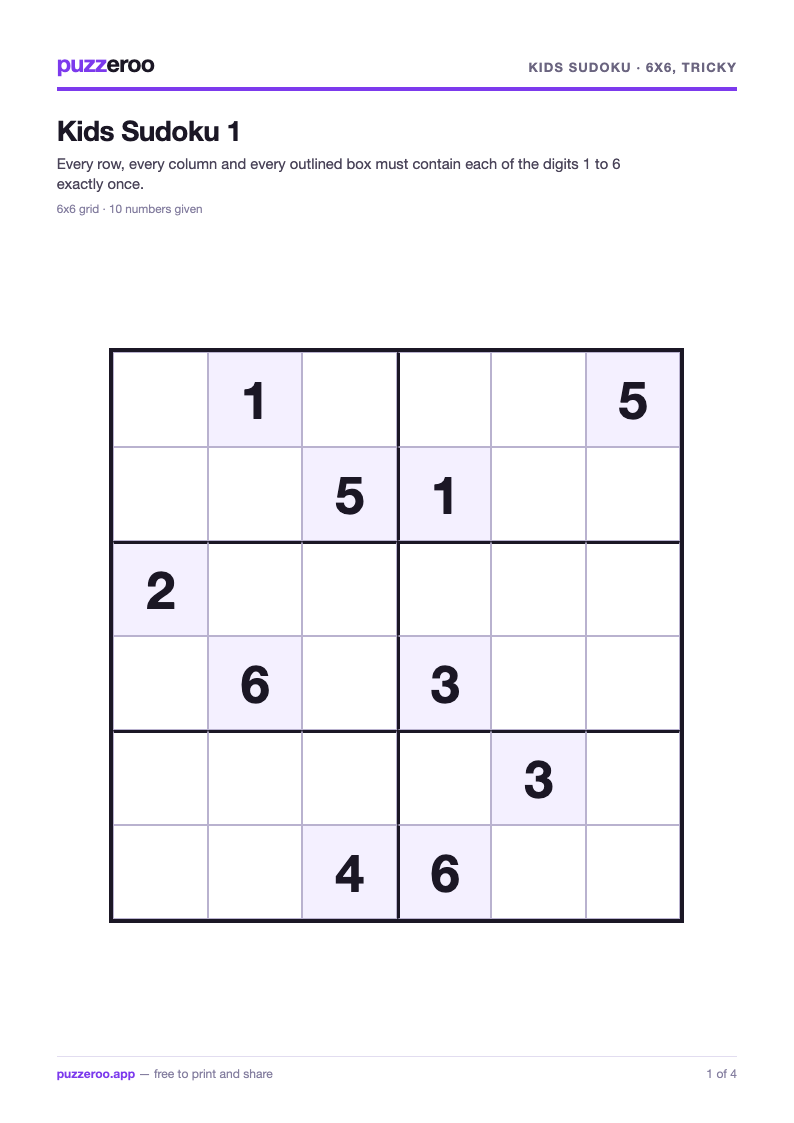
6x6, tricky
Three free printable hard 6x6 sudoku puzzles for ages 9-12, with answers.
Download the PDF →
- Four A4 pagesThree puzzles, then a full answer key. Print the first three only if you would rather keep the answers.
- One verified solution eachEvery puzzle is passed through a solver and discarded unless exactly one answer fits.
- No sign-up, no watermarkA direct PDF download. No email address, no account, nothing to dismiss.
- Free to photocopyUse them at home, in a classroom, at a childminder or in a holiday club.
Which pack for which age?
| Kids Sudoku pack | Ages | What it asks of them |
|---|---|---|
| 4x4, easy | 5-7 | First sudoku ever. 16 squares, digits 1-4, most of them already filled in. |
| 6x6, easy | 6-8 | Solvable by "what is missing from this line?" alone. No advanced steps needed. |
| 6x6, medium | 8-10 | Squares stop giving up answers; the child has to start asking where a digit can go. |
| 6x6, tricky | 9-12 | Rewards working a whole box or line at a time rather than one square at a time. |
How to solve a kids sudoku
One rule, applied over and over. Teach the "scan for what is missing" habit and the rest follows.
- Learn the one ruleEvery row, every column and every outlined box must contain each digit exactly once. That means 1 to 4 on a 4x4 board and 1 to 6 on a 6x6 board. No digit may repeat inside a row, a column or a box.
- Hunt for the nearly-full lineFind the row, column or box with the most digits already filled in. If only one digit is missing, you can write it in immediately with no thinking at all. This is the confidence-building move. Start every puzzle here.
- Ask what a single square can bePoint at one empty square. Read its row aloud, then its column, then its box, crossing digits off on your fingers. If only one digit survives all three checks, it belongs in that square. This is called a "naked single".
- Ask where a single digit can goWhen squares stop giving answers, flip the question round. Take one digit, say 4, and look at a single box. Cross out every square in that box whose row or column already holds a 4. If one square is left standing, the 4 goes there. This is a "hidden single".
- Never guessIf neither question yields anything, the answer is still there. Go back and re-check a line you skimmed. Every puzzle in these packs is solvable by the two questions above alone, so a guess is always a sign that something was missed, not that the puzzle is unfair.
Common questions
What age can a child start sudoku?
Around five, on a 4x4 grid, as soon as they can reliably count to four and recognise the written digits. The 4x4 board is small enough that a child can hold the whole thing in their head. Most children move up to 6x6 between seven and eight.
Do these printable sudoku puzzles come with answers?
Yes. Every pack is four A4 pages: three puzzles, then a full answer key on the last page. Print the first three pages only if you would rather keep the answers to yourself.
Is there only one correct answer to each puzzle?
Yes, always. Every grid is passed through a solver that counts solutions and is rejected unless the count is exactly one. That is what makes the answer key trustworthy.
Can I use these worksheets in my classroom?
Yes. Print, photocopy and hand out as many as you like, in school, at a childminder or at home. They are free for classroom and home use. Please do not resell them or strip the puzzeroo.app footer.
What does sudoku actually teach?
Deduction and elimination rather than arithmetic. There is no adding in sudoku at all. A child practises holding a constraint in mind, testing candidates against it, and accepting that an answer must be true because everything else has been ruled out. That is the same shape of thinking as a proof.
Other free printable puzzles
The same puzzles, on an iPad
Puzzeroo has two hundred mini sudoku levels and six hundred more across the other three puzzle types. It works fully offline, shows no adverts, asks for no account, and costs one payment rather than a subscription. The worksheets above are generated from a separate puzzle range, so they never duplicate a level in the app.