 puzz
puzzEasy printable 6x6 sudoku for kids
Six digits, thirty-six squares, and boxes that are two rows tall and three columns wide. The 6x6 board is the real thing in miniature: unlike a 4x4 it is big enough for a digit to hide, so a child has to hunt for it rather than spot it at a glance. It is the board most children spend a year or two on before 9x9 stops being intimidating.
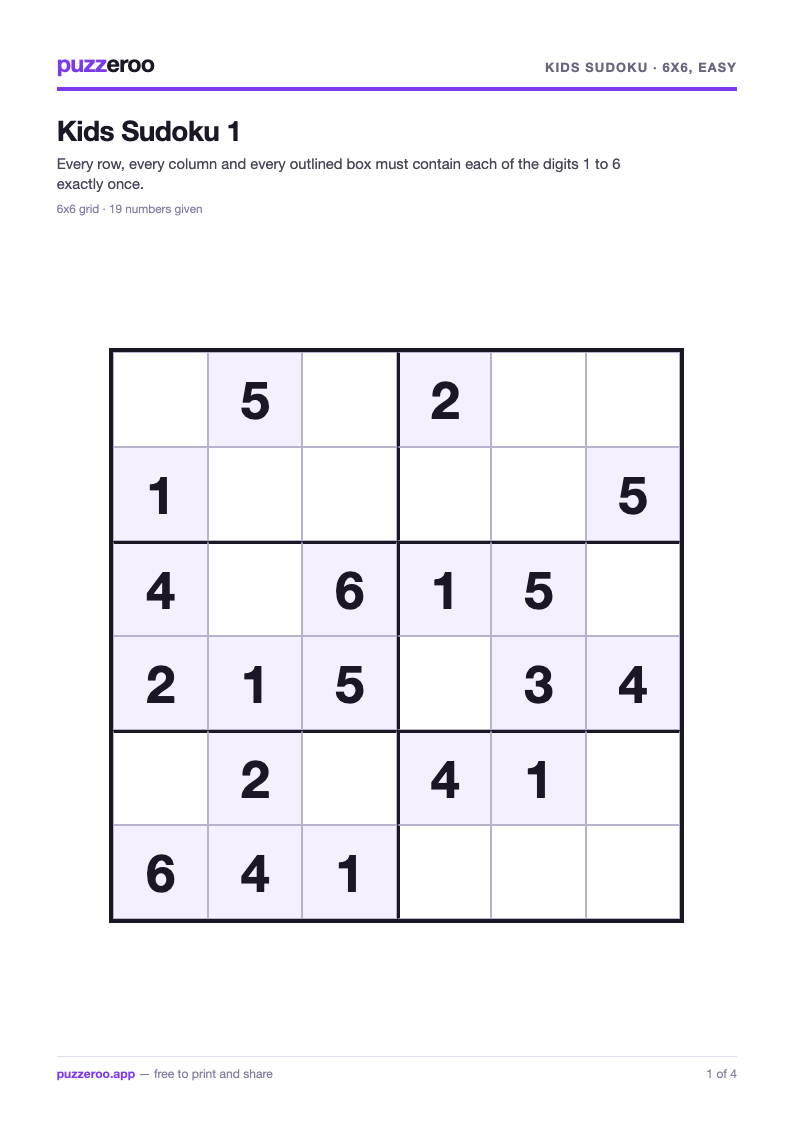
This easy pack is deliberately generous. Eighteen to twenty-four of the thirty-six squares are already filled. More importantly, each grid is verified to be solvable by the single simplest technique: repeatedly finding a square where only one digit can possibly go. A child never has to reason about where a digit must go, only about what a square can be. That constraint is checked mechanically, not estimated.
What is in this pack
| Grid | 6x6, thirty-six squares, boxes 2 rows x 3 columns | |
|---|---|---|
| Digits | 1 to 6 | |
| Clues given | 18 to 24 of 36 | |
| Solving level | naked singles only, verified rather than estimated | |
- Four A4 pagesThree puzzles, then a full answer key. Print the first three only if you would rather keep the answers.
- One verified solution eachEvery puzzle is passed through a solver and discarded unless exactly one answer fits.
- No sign-up, no watermarkA direct PDF download. No email address, no account, nothing to dismiss.
- Free to photocopyUse them at home, in a classroom, at a childminder or in a holiday club.
Teaching tip. Teach the child to work one box at a time rather than roaming the grid. A 2x3 box borders two rows and three columns, so it collects information from five lines at once and is usually where the next answer is sitting.
How to solve a kids sudoku
One rule, applied over and over. Teach the "scan for what is missing" habit and the rest follows.
- Learn the one ruleEvery row, every column and every outlined box must contain each digit exactly once. That means 1 to 4 on a 4x4 board and 1 to 6 on a 6x6 board. No digit may repeat inside a row, a column or a box.
- Hunt for the nearly-full lineFind the row, column or box with the most digits already filled in. If only one digit is missing, you can write it in immediately with no thinking at all. This is the confidence-building move. Start every puzzle here.
- Ask what a single square can bePoint at one empty square. Read its row aloud, then its column, then its box, crossing digits off on your fingers. If only one digit survives all three checks, it belongs in that square. This is called a "naked single".
- Ask where a single digit can goWhen squares stop giving answers, flip the question round. Take one digit, say 4, and look at a single box. Cross out every square in that box whose row or column already holds a 4. If one square is left standing, the 4 goes there. This is a "hidden single".
- Never guessIf neither question yields anything, the answer is still there. Go back and re-check a line you skimmed. Every puzzle in these packs is solvable by the two questions above alone, so a guess is always a sign that something was missed, not that the puzzle is unfair.
Who this pack suits
Solvable by "what is missing from this line?" alone. No advanced steps needed.
How the kids sudoku packs compare
| Kids Sudoku pack | Ages | What it asks of them |
|---|---|---|
| 4x4, easy | 5-7 | First sudoku ever. 16 squares, digits 1-4, most of them already filled in. |
| 6x6, easy | 6-8 | Solvable by "what is missing from this line?" alone. No advanced steps needed. |
| 6x6, medium | 8-10 | Squares stop giving up answers; the child has to start asking where a digit can go. |
| 6x6, tricky | 9-12 | Rewards working a whole box or line at a time rather than one square at a time. |
Questions about this pack
What is the difference between 4x4 and 6x6 sudoku?
Size and honesty. A 4x4 uses digits 1-4 in 2x2 boxes and can be taken in at a glance; a 6x6 uses 1-6 in 2x3 boxes and is large enough that a child has to search systematically. 6x6 is the smallest board on which a sudoku can be made difficult at all.
Why are the boxes rectangular rather than square?
Because six does not have a square root that is a whole number. To divide thirty-six squares into six boxes of six, the boxes have to be 2x3. It changes nothing about the rules. Each box still needs every digit exactly once.
Is easy 6x6 sudoku suitable for Year 2?
Usually yes, if the child has already met 4x4. Year 2 and Year 3 (US grades 1-3) is the typical sweet spot for this pack. If a child is still counting on fingers to check what is missing from a line of six, spend longer on 4x4 first.
What should I do if my child gets stuck?
Ask them to find the row, column or box with the most digits already in it, and work there. On an easy pack there is always at least one square somewhere that can only be one digit, so being stuck means a line has been skimmed rather than read.
More free worksheets
Other kids sudoku packs
Other kinds of puzzle
See all 17 free worksheet packs.
Hundreds more of these in the app
Puzzeroo is an iPhone and iPad app with two hundred mini sudoku levels alongside three other puzzle types, eight hundred in total. The same verified engines that made this worksheet made every one of them, and they all work fully offline with no adverts and no accounts. The worksheets and the app draw from separate puzzle ranges, so printing these gives nothing away.